Showing posts with label Cost-Free. Show all posts

9-11 Memorial Garden and Trail

The Monsters are due on Maple Street. Map
From 9-11 Memorial Garden


A close look at the calendar reveals that today is the 10 year anniversary of one of the marquee moments in living American’s lives. The very date of September 11 invokes an imaged of terror and death, and marks a sea change in the way we see ourselves as a people and as a nation. I feel compelled to take notice of the event as I am a red blooded American, but I shall do so in typical Baboon fashion, by telling the story of a geographical location within driving distance of Atlanta (about 1½ hours away) created by a U.S. Citizen, Georgia resident and folk artist by the name of Bob Hart near Athens. The place is called the 9-11 Memorial Garden and Trail, which is located on his property and is open to the public at 320 Morton Farm Lane in Athens GA.


Mr. Hart, a retiree from the University of Georgia, was so moved by the moments of that fateful day that he felt compelled to create something and made a personal monument to the tragedy and to the lessons which, hopefully, a grieving nation learned that September morning. It would be categorized as a folk art piece which I believe is fitting for a moment that struck a chord with every echelon of person in American Society. It is a simple trail about 300 yards in length walking through a young forest. As you enter, there is a visitor’s sign-in book and a copy of the book, Portraits: 9/11/01: The Collected "Portraits of Grief" from The New York Times, which gives a short bio of every person killed in the attacks. The construct that holds the books is adorned with two quotes from Holocaust survivor Elie Wiesel. The first reads, “Memory may be our most powerful weapon against fanaticism” and the second adds, “To live through catastrophe is bad, to forget it worse.” These sentiments are well chosen and well said to get your mind in the mood for a reflection of the events of 9-11.


The artwork itself is simple and mostly abstract, with items representing special numbers or places related to the day. As abstract art is often difficult to understand, the artist has placed several markers explaining his intentions. And they are rather straightforward, saying things like the red beam on the Pentagon Memorial represents the side that was struck by the aircraft and which was still on fire at the time of the monuments creation. There are four such special memorials along the trail: the Pentagon, the World Trade Center, Flight 93, and one to the noble concepts of Faith, Hope, and Love (this last piece has contributions from Athens artist Mary Padgelek). There are also a few other pieces of art placed throughout the trail, the most notable being an iron sculpture near the front called Migrations by local artist Harold Rittenberr. There are also several benches to sit upon for rest and reflection.


The most thought-provoking works are the signposts along the trail. They were simple wooden posts that resembled directional signs. There were 99 of them, a number chosen by multiplying the numbers in the date of the tragedy. On each sign were the hand painted names of every human being who died as a direct result of those terrorist attacks. These brought back vividly the human cost of the 10 year old event. They were people out there, like you and me, who were killed in this senseless act, and the power of a person’s name can bridge the gap between abstract and reality. Each is a person who had a job and a family and hopes and dreams. Atop each pole is a small hand painting, often of the U.S. Flag, but at other times about other concepts that should also not be forgotten like Love, Liberty, and Justice.


It would be difficult to visit such a place and not reflect on the attack on the United States, which brings me to the thoughts that swirled in my head at the memorial trail on that infamous moment and the 10 years hence. I remember the events as we all do. The feelings we all have are fairly universal; anger, sadness, fear, disgust, are all common. I was struck deeply by the days that followed. For a short while, we acted as one America in love with the country, what it stands for on its best days, and our fellow countrymen. I was so moved I even rooted for the Yankees during the November Series (and I am a baseball purist, as you know, and that is a monumental step).


But that feeling of fellowship and brotherhood drifted away from us. We let the worst parts of our collective psyche take over. We became a country filled with infighting. We became a country that trashed our 1st amendment protections, especially when it came to Muslim Americans. We became a country that was horrified to see Americans die in the destruction of iconic building, but who could make a top priority repealing a law that might keep fellow Americans dying due to lack of or inadequate healthcare. We became a country who trusted no one, and even questioned the legitimacy of birth of the person in the highest office in the land. We became a country that applauds at the mere mention of executions and that holds parties at the news of people’s deaths. We became a country that invades other countries for little or no reason, a renewed imperialism. We became a country that no longer cared about our hopes to be the beacon on a hill for all to emulate. We became a country that no longer cared about justice, right and wrong, and our fellow man, let alone our fellow citizens. I can’t help but look at the 3,000 names printed with love on the signposts and think that they would turn over in their graves, if they had graves and knew this was their legacy: that we the living, have let them down, and allowed their deaths be in vain.


So that’s the feeling I get from spending time at Bob Hart’s 9-11 Memorial Trail. They are holding a Commeration there at 6:30pm today and I encourage you to visit then, or at another time, when you can. Look at the names and look for the strength to be a better person and American. I know that this place challenged me to be just that.


There is a video you can watch here Watch.


Trail Essentials
Approximate Time: 1 hour
Approximate Distance: .2 miles
Features: Art Installation, Tribute to 9-11 dead, Folk art

Overall Rating: B

Scenic Quality: A
Athleticism: D
Solitude: A
Value: A
Parking: Free, but only for three cars 
Hours of Operation:  Doesn't close, but be respectful of property owners and neighbors
Facilities: None 
Maps: Not needed
County: Clarke


Auchumpkee Creek Covered Bridge

We can rebuild it…. Map
From Auchumpkee Covered Bridge


OK, Some may criticize this post as just another covered bridge post in my seemingly endless quest to view and photograph every covered bridge within a reasonable drive of my home just outside of Atlanta, and to them I say sure you are right. There is something strangely attractive and compelling about covered bridges and I have been sucked in. This doesn’t make the covered bridge less cool, I really love seeing this friendly reminders of a bygone era in the Georgia Countryside. Today, I bring you a bit of information and photos of the Auchumpkee Creek Covered Bridge, just 1½ hours South of Atlanta, near Culloden in Upson County, Georgia.


The original bridge was built in 1892 by Herring and Alford, in the Town Lattice design. It spans the Auchumpkee Creek, originally at 120 feet in length, but currently at 96 feet. It has also been called the Hootenville Bridge, after the community of Hootenville that was once there. And Zorn’s Mill Bridge based on a nearby and now missing mill.

It seems the bridge was restored twice. The first one in 1985 was more of the general restoration you see in a lot of these bridges. The latter in 1997 came after terrible flooding in that part of Georgia destroyed the bridge, this was done by the firm of Arnold Graton & Sons. They used as much of the old bridge as possible, but there’s more new here than old. But I’m glad to see that it is truly in the spirit of the original bridge.

The bridge is located about 40 feet off the of Allen Road, a little bit East of GA 19 and about 10 miles South of Thomaston, Georgia. In addition to the bridge, the stream is pretty and apparently a decent place to fish. There is one picnic table that we utilized with pleasure. There are no facilities at the site.

So if you are a Covered Bridge Buff and want to see another of these quaint pieces of history, Auchumpkee Creek Covered Bridge is a pleasant diversion. It is held up well because of the rebuilds and the distant location has limited the destructive influences.


Moore's Ford Lynching (part I)


Part I (Background)
From Moore's Ford Lynching


65 years ago, as of the publishing of this post, a terrible event occurred in the vicinity of the place where we all live. When you hear of tragic events like this, a part of your mind thinks, maybe wishes, that it is only a thing of the past to be forgotten like the Horse & Buggy or the 8-track tape. But there is a danger in forgetting too much history, especially the parts that make us nervous or queasy. My attempt to alleviate the perils of history forgotten will stand with the GABEO, and there presentation of the events surround the last mass lynching in the United States, or what is most commonly referred to as the Moore’s Ford Lynching.

The Dark event occurred on July 26, 1946 (Time Article). Not so long ago that there aren’t people still alive who remember the event. Four black people, George & Mae Murray Dorsey and Roger & Dorothy Malcom, were taken from a car at the bridge across the Appalachee River at the Walton-Oconee County Line, where they were repeatedly shot, some reports say 60+ shots were fired, ending their young lives. There is much more to the story: It came during a period when the idea of lynching a black person was something society knew was a practice, especially in the South. It came at a time prior to the rise of Civil Rights leaders such a Martin Luther King, and any real semblance of equal citizenship for black Americans. This was the way things were done in that period of American History, as ugly as it may be, we do ourselves great harm if we look away.

The Georgia Association of Black Elected Officials (or GABEO) feels the same way. And for the past several years they have held a commemorationof the event of that dark July night. This year is was this past Saturday, July 23rd. The first purpose is to keep this unsolved case from seeping out of our collective memories. The second purpose is that it stands to reason that somebody who lives in the area may have information that could bring the perpetrators of the murder to justice.

The Day began with a rally at the First African Baptist Church of Monroe at Noon. I can attest by my present that all were welcome to attend this event. It gave the organizers about two hours to get everyone together to make the trip around Monroe. During this time, Black elected leaders, community leaders, and religious leaders spoke to edify and amplify the attendees. There was also a fair amount of music and an introduction of the actors.

The first scene was done at the church. The players were Barnette Hester, Roger Malcom and Dorothy Malcom. Apparently, Barnette had made some disparaging comments about the propriety of Dorothy Malcom, and Roger aimed to do something about it. Roger confronted Barnette and a scuffle ensued. In the melee Roger stabbed Barnette and then fled. The historical versions of this event say that Barnette was armed with a pitchfork, and that it may have been sexual advances or even actions toward Dorothy that raised Roger’s ire. Any way you slice it, it was not a good time in history for a black man to stab a white man. Roger ended up caught and imprisoned for 11 days. In the past this part of the reenactment was held in front of Barnette Hester’s house at 2932 Hester Town Road. But due to logistics, and some trepidation, they decided to do this part at the church.

Click here to continue to PART TWO

Moore's Ford Lynching (Part II)

Part II – The Graves and Sites
From Moore's Ford Lynching


There then was a break from the action. They had made a decision to visit the graves of the victims and they were buried in three separate locations. The first stop was the Mount Perry Missionary Baptist Church in Appalachee, Morgan County. Here the bodies of George and Dorothy (Malcom) Dorsey were interred side by side. Most of the graves at the cemetery were simple wooden crosses, and when the Dorseys were buried they had the same. The Moore’s Ford Committee placed granite markers on all the lynching’s victims some years back. In front of George’s grave, there was a plaque recording his military service record, including the three medals he earned in service for our country during WWII. A prayer was said over the grave and we moved on to cemetery #2: Chestnut Grove Baptist Church in Rutlege, Morgan County, where Roger Malcomwas buried. Roger’s grave looked pretty much the same as the other, an elegant granite slab replacing the modest original marker. After the benediction here, we moved to another headstone, that of Lynn McKinley Jackson who died on August 8, 1982. Lynn was found hanging from a tree in Walton County, and even though most might think it suspicious, the local authorities ruled it a suicide. According to the GABEO leaders, they believe he was lynched as a result of his being involved in interracial relationships. After a prayer over Mr. Jackson’s grave, we moved on to the final gravesite.

The entire motorcade journey would wind up taking us better than 60 miles in total. The distances between the gravesites were the most substantial being 15 miles or better. The path to Mae Murray Dorsey final resting place took us through Hestertown. Hestertown, if you recall, was where Barnette Hester’s farm was and where the first scene was supposed to take place. Along the road, there were several old houses and barns, forming what might be almost a stereotypical idea of what rural country life in Georgia is like. The strange thing was the number of folk sitting on their front porches watching us drive slowly down there road. Many of them waved at me. This would normally be an endearing portrait of Southern warmth, if the fact was not known that there was little doubt someone from there either knew something, or knew someone who knew something about the unsolved murders. Were they greeting us or letting us know they had their collective eyes on us. It was an eerie experience.

Mae Murray Dorsey was buried at the now defunct Zion Hill Cemetery at 224 Alcovy Street in Monroe, Georgia. If you go to this site, you will notice a small office park with numerous small businesses. We parked there and in a field adjacent to the parking lot there were a fair number of graves marked with simply wooden crosses. We made our way down to the granite marker commemorating Mrs. Dorsey’s death. The marker has been place in the field apparently next to the grave of a member of Mae’s family because the actually grave is somewhere under the paved parking lot. A sad story true, but no more than the entire situation.

We then made our way to the Monroe Courthouse Annex IV at 203 Milledge Avenue in Downtown Monroe. In 1946, this building served as the jail where Roger Malcom was kept for the stabbing of Barnette Hester. At this site there were two reenactments. The first was of Eugene Talmadge’s stump speech taken from notes and recordings of the day. Mr. Talmadge had arrived in Monroe, two day s after the Hester stabbing. In this speech, he makes several references to purifying the Democratic Primary saying that black can vote in this election, but if elected he’ll make sure blacks won’t be voting in the next. The implication is that a racially inflammatory speech might have riled the mob into action against Roger Malcom. Some sources imply there was a direct deal between Talmadge and the Klan that their version of Justice would be permitted. The second reenactment centers around a man named Loy Harrision. Mr. Harrison had been George and Roger’s employer and apparently Mae and Dorothy were able to convince him to put up the $600 to get Roger out of Jail. Loy, pulled up in his car, along with George and the two women, and bailed Roger out. For the moment, the four were happy and filled with a spirit of reunion. They would work off their debt to Mr. Harrison and life might just return to normal.

But that brings us to the final reenactment, we drove down to Moore’s Ford Bridge. On the way, we saw the historical marker at the corner of Highway 78 & Locklin Road. Continuing down Locklin, 2.4 miles later we were at the bridge. The exact location is Mt Carmel Church Road, where the Appalachee river divides Walton and Oconee Counties. We had to walk about a half mile down to the bridge. It is now a concrete modern bridge, but at the time of the lynching it was a simple wooden structure. There is a signpost for Moore’s Ford Road, but there really is nothing there but a dirt path. At this place, the final confrontation was dramatized. For some unknown reason, Mr. Harrison decided to drive this circuitous route how with his four black travelling companion. We piece together the event of the day based on Loy’s testimony. First, armed Klansmen stop the car at the bridge, they pull the George and Roger out kicking and screaming. Roger’s crime was known to all, but apparently George had become to uppity after the coming back from the war or possible he was too friendly with white women. Mae recognized one on the armed men, and then the women had to be dispatched because they could have no witness. The four were tied together with a rope and shot over sixty times to make sure they were dead. They were then left in the field to rot. Hours later, funeral director Dan Young came to pick up the bodies for final preparation. Prayers were said and songs were sung concluding the reenactment.

Click here to continue to PART THREE

Moore's Ford Lynching (Part III)

Part Three – Conclusion

From Moore's Ford Lynching


In the interest of fairness I want to address a few issues that cause some turmoil around these reenactments.  The first is the strange call for accuracy.  A number of people thing that the reenactment is inaccurate, but the presenters know full well that there is not a valid account of the murders.  If there were then the perpetrators would have at least been tried.  If you rail about inaccuracy then you probably know something and should assist the authorities to finding justice.  Aside from the actual shooting, they point to the story of Dorothy Malcom’s pregnancy  as being apocryphal.  Laura Wexler, who wrote the definitive book on the subject, Fire in a Canebrake, as well as her family members disagree with this stance.  The presenter of the reenactment claims that he was told of the pregnancy by the funeral director Dan Young.  This idea is even recorded, using the word “reportedly” on the historical marker.  Those who believe the story even gave the child a name a few years ago, fittingly, it was “Justice Malcom.”  To those who object to this story, I say who really cares if she was pregnant or not?  Does it make the crime of murdering four people better?  As if somehow, a person might think I can live with you accusing me of murder, but don’t you dare label me an abortionist.  Albeit if it were true, it would add a fifth lost soul to the mix.  If the idea gets you riled, I think that’s the point.  They want you to come forward and set the record straight.  If I were making stuff up, I would do a lot more than just have the one girl pregnant.  I might go with the one report that had the Klansmen having sex with children, animals, and other men in a bloodlust frenzy.   You can’t tell me it didn’t happen, unless you know something and should come forward for the sake of justice.
The second thing to note is that this is not the last lynching in history.  We already talked about Lynn McKinley Jackson’ s story at Roger Malcom’s gravesite.  I was also told the story of Fredrick Jermaine Carter, who appears to have been lynched way back in December of 2010.  Sure, this wasn’t Georgia, but rather Mississippi, and it was ruled a suicide, but it has all the earmarks of good old fashioned mob justice.  These stories make us all understand the importance of remembrance.  We need to be vigilant against the atrocities that mankind is capable of so that we can minimize, stop, or prevent the darkest side on the human soul from gaining control.  I would be nice to think this American problem of lynching has been solved, but you would be kidding yourself. 
The final thing is probably the most scary to me, personally.  I’ll start by addressing the most frequently asked question: “If Dorothy, Mae, Roger and George were shot, why is it called a lynching?”  A lynching can mean the hanging of a human by rope from a tree and that may be the most common form of these murders, but in a more general sense it means putting someone to death without legal means, most often by  a mob.  That was the case in the Moore’s Ford murders.  The thing that scares me is the lynch mob mentality I see around us every day.  And it’s more than a black and white problem.  We sit a mere month out of this big Casey Anthony trial in Florida, and although acquitted, I’ve heard more than one person say she should be killed.  It’s a running meme on the internet to get Dexter and Casey introduced.  The comedians are joking about her guilt without regard to the justice system.  But a day like last Saturday helps me realize that the very same passions and rage which stopped the car at the Moore’s Ford Bridge, which led to the shooting death of four black people, are the same passions we kindle today.  We must learn to not just love justice, but to respect it.  To understand that the trial by jury is the seed from which all democracy and freedoms grew, planted in the Magna Charta centuries past.  If we can’t respect Justice in our community, then we no longer have a community and have digressed to the worst possible outcome of democracy: Mob Rule. 

Hurricane Shoals Covered Bridge

New Look at Something Old map
From Hurricane Shoals Park


Now there’s something about a covered bridge that transports some of us to a different time and place. They are highly romanticized. But what is it about them? Is it their age? I ask this because I see a small trend in Modern Covered Bridge Building and wonder if it deserves the same notice as the old ladies that stand guard atop our Georgia Rivers. I tend to lend toward thinking so, and thus the story of the Hurricane Shoals Covered Bridge in Maysville, GA.

To be fair, it wasn’t like the folks of Jackson County just up and decided to build a new modern covered bridge one day. This new bridge is built on the site of the “Old” Hurricane Shoals Covered Bridge (photo here) erected way back in 1882, when the area had need of a bridge for the nearby mills. That 127 foot town lattice style bridge was burned to the ground after 9 decades of service by heartless vandals on Memorial Day of 1972.

After years of effort, funding was made available to rebuild this bridge in 2002. The bridge has the same dimensions and style but is clearly built with modern know-ho. This re-envisioning of the romantic countryside sentry is definitely an interesting object to contemplate for a moment. How many great things of the past can we actually improve on? Or does this modernism diminish its aesthetic purpose? I won’t answer these questions for you, but I do promise to show a few other modern bridges on this site in the future.

This bridge stands as a connector between the two parts of Hurricane Shoals Park in Maysville. On one side you have the tumbling waters of the North Oconee River and the other you have the old building of their pioneer village, which were discussed at length in previous articles.
From Hurricane Shoals Park
What you have in the Hurricane Shoals Covered Bridge is a nice modern interpretation of a classic idea. It sits just a pretty as the others, if not a little cleaner, and maybe a little happier. This bridge is a welcome addition to the Georgia Landscape.


Gorges State Park NC
(Horsepasture River)

One, two, three, four…4 beautiful waterfalls bah ah ah Map
From HorsePasture River Falls


I always feel a little guilty when I talk about something not in Georgia, like I’m abandoning my adoptive home state for something I think is better in a new state. It’s not like I’m cheating on my wife or anything. The point of this website is to show really cool places to hike or visit within a reasonable drive of Atlanta, normally 3 hours. This place Google maps puts at 3 hours and 16 minutes from downtown Atlanta, but you know the way we drive, if you can’t make up the 16 minutes on the road, then you’re probably not from Atlanta. And this place is really cool, I am talking about the Waterfall Hike on the Horse Pasture River very near Gorges State Park in Sapphire, NC, North Carolina.

I read about this hike in the Back of the Dillard House Cookbook. It seemed almost too good to be true with 4 waterfalls in such a short distance. But If you are going to spend three hours in the car, you want something kind of special. When we got there, it was just a pleasing as advertised. I must note that you should beware of other information on getting to these falls. North Carolina State Parks closed one path in May of 2009 and set up the new path out of Gorges State Park (the Cookbook’s directions were to the old spot). You drive into the park about two miles, and the parking is clearly marked and as of Oct 2010 free. There are two paths leading out of the parking area, and the way to Horse Pasture River is the one on the right. The path actually takes you out of Gorges State Park and into Pisgah National Forest, so when you see the signs saying you are leaving the State Park, you are going the right way.

The first 1.5 miles of the trail is rather uneventful. At about 1 mile you start seeing the river downstream of the falls. In this area, there is a small falls (about 5 feet) called Hidden Falls. At 1.5 you see the granddaddy waterfall of the trip Rainbow falls, dropping a majestic 150 feet. You can view this fall from just about any angle you want but be careful, as this point is the only point that has any kind of precautionary railings.

About .25 mile up from Rainbow Falls, you come upon Turtleback falls, this is one of those falls just perfect to play in. I’ve seen kids slide down the 20 foot falls and cool off in the waters below. There isn’t the kind of danger here that the 150 foot falls presents. If you continue about .25 miles up from here you will get to the edge of the public land and can view Drift Falls. Remember, Drift Falls in on private property and if you get caught in it, you will be fined. Somewhere downstream from Rainbow Falls is Stairstep Falls, to which I didn’t travel. It is supposed to be about a mile downstream from Rainbow Falls.

So if you, like me, like waterfalls and a good hike and don’t really mind a three hour car ride, Gorges State Park offers tremendous bang for your buck by these criteria. I know a lot of folks have recommended several places for me to visit in NC. If they are half as good as this one, then you know I will be back.

(in the video I mistakenly refer to Hidden Falls as Stairstep Falls)

Trail Essentials
Approximate Time: 2-3 hours
Approximate Distance: 4.5 mi round trip
Features: Waterfalls, Riverside Walk

Overall Rating: A

Scenic Quality: A+
Athleticism: B+
Solitude: B
Value: A
Parking: Free
Hours of Operation: Daylight hours for Parking
Facilities: None (Oct 2010, but there are plans)
Maps: Downloadable on this page
County: Jackson County, NC

Buford Dam

The Birthplace of Lake Lanier Map
From Buford Dam


Recently, there has been a lot of talk about the dangers of the Chattahoochee River with outdoor enthusiasts being in need of rescue. In more extreme cases, drowning occurs. And it seems that all the blame for this goes to a little marvel of modern technology known as the Buford Dam.

Built in 1956, the Buford Dam does several things for us in Metro Atlanta besides try to kill us. It does a nice job of Flood Control with only two significant floods South of Dam since its inception. It provides power; it aids in wildlife management; and it helps with our water supply. In order to do these things, it has a continuous release Schedule that is irregular. Water is released from Lanier daily, but some days it’s a little and some days it’s a lot. The more water that is released the more dangerous the river becomes, so check at the phone number (770) 945-1466, so you will be adequately prepared.

Visiting the Dam is an interesting excursion in its own right. Some write this up as a trail, and so I will do the same, but I warn it is very short at only about a mile, if you park at the Lower Overlook Park to save on parking fees at the Dam itself. On the bright side, it is a very easy excursion for those who can do limited physical activity, the physically-challenged, or even small children.

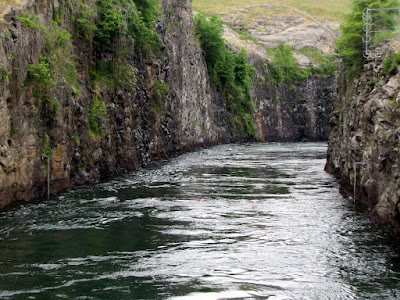
In the one mile space, 3 things jump out at me of interest. The most obvious of which is the rocks and formations of the dam itself. There is a nice little steel frame bridge with great views of the dam or down the Chattahoochee. The second is the sheer clarity of the water. As the water released from Lanier comes from the bottom of the lake, it is crystal clear in spite of the heavy boat usage there. Finally, and probably the most odd, is the wildlife in the area. Of course there’s ducks and fish, and that’s to be expected. But there are also a fair number of goats living just inside the fences at the dam.
You can also watch the fisherman at work (or do they call it play) as it is popular for this activity.

So if you looking for an interesting side excursion on your trip to Lanier or a short jaunt off the LLaurel Ridge Trail Laurel Ridge Trail on your more extensive hike, the Buford Dam is a shouldn’t miss place just at the Forsyth-Gwinnett County Border. On a beautiful day, it is another option to get you outside. And the sirens you hear are announcing the release of water.

Trail Essentials
Approximate Time: ½ - 1 hr
Approximate Distance: 1 mi.
Features: Dam, River View, Wildlife

Overall Rating: C+

Scenic Quality: A-
Athleticism: C-
Solitude: C-
Value: B
Parking: Free (lower overlook park) Charge at Dam Parking
Hours of Operation: Daylight Hours
Facilities: At Lower Overlook Park
Maps: None, Follow Laurel Ridge Trail to Dam (marked trail), and return same way
County: Forsyth

Sweet Water Brewery

FREE BEER (4 days a week) Map
From Sweetwater Brewery


About two decades ago, I was really into beer. I did all the stuff you would think a guy who was into beer would. I even made my own, and got pretty good at it. But for the last decade of my life, I’ve steered away from beer first toward neutral and then less neutral spirits. But it doesn’t mean I don’t still appreciate a good beer. And I am glad that Atlanta has got a worthy craft brewery to represent us in the Sweetwater Brewing Company, just off the Peachtree Exit on I-85, located at 195 Ottley Drive in Atlanta.
From Sweetwater Brewery
Now this is not exactly a secret, as the crowds can attest, but it doesn’t mean it’s not worthwhile. Every Wednesday, Thursday, & Friday from 5:30p-7:30p (and Saturday from 2:30p-4:30p), these guys basically open their doors to the public to visit and taste some fine Georgia draft beers. They do two things: they operate a tasting room and they have a tour of the facilities. They are both technically free, though most patrons will opt to spend the $8 on a souvenir glass because you will get significantly larger “tastes” of the beers and they make nice keepsakes.
At the tasting room, you have a choice of their 5 Standard Brews: 420, IPA, Sch’wheat, Georgia Brown, and Blue, as well as one seasonal brew, they call “Catch and Release,” which was for us something called Motor Boat. As I knew before coming there, these guys know what they are doing and the beer is solid.
I would rank IPA & 420 as very good; Georgia Brown, Motor Boat, and Sch’wheat as good (though I’m not partial to wheat beers—I believe it’s done nicely); and Blue as just plain weird. Blue has an odor of Boo Berry cereal and that olfactory experience is so discordant that I can’t even tell you what it tastes like. That being said there’s a market for less beer-like beers and that’s apparently what they are going for. I do want to reiterate that the other beers were good to very good. Heck, I can honestly say that “I don’t often drink beer, but when I do I normally drink 420.”

The tour is a little underwhelming. After touring various whiskey distilleries, I probably expected a bit too much from this. With the large crowd it is hard to accomplish any kind of meaningfully informational tour, and I bet that most of the folks there didn’t really care that much. When they asked if anyone brewed beer at home only me and one other tour patron raised their hand. But considering the obstacles, it came off quite well. The impression I received was that this open house and tour was Sweetwater Brewery’s honest and sincere way to say thanks to its patrons. This type of heartfelt connection to a company’s customers is pretty rare, but nice to witness. It was also nice that the second half of the tour was held inside the huge walk-in cooler, allowing a nice way to beat the heat, if just for a few moments.

So if you like beer or know someone who does, and are over the age of 21 (this is important – no children are allowed), a trip to the Sweetwater Brewery is good way to spend a few hours of your day on the way to some Atlanta evening destination. Be prepared to drink, for crowds, and to walk a short distance from parking to the buildings. As I said, they seemed to thank me for my patronage, this article is my Thank You to them just for being there.


ShareThis

Related Posts Plugin for WordPress, Blogger...