Showing posts with label Cost-Under $10 per Person. Show all posts

Pasaquan

EOM on the Range map
From Pasaquan


There are several notable artists that come from or have resided in Georgia. I don’t write about them all, but when one artist describes himself as the “Bodacious Mystic Badass of Buena Vista,” it makes this monkey sit up, take notice, and put a visit to his home on my list of things to do. Now, it has taken me some time to manage the trip, with its 2.5 hours of traveling and pretty restrictive operating hours. But I got there and wanted to tell you about it. If you don’t know what I am talking about, this is about Pasaquan, the residence and artwork of the lovably mad Eddie Owens Martin, near Buena Vista, Georgia.


For a couple of years now, the site has been open to the public on the first Saturday of each month during the summer. They do charge a $5 donation/admission, but it goes to the preservation of the home and is well worth it. As I have said, the hours are short, being only open from 10am to 4pm on that one day a month.


What you get to see is patchwork of geometric patterns married to mystic, Indian, and religious symbols. Driving up the deserted and aptly named Eddie Martin Road, this outlandishly decorated home is woefully out of place in the middle Georgia countryside. But I say this in a good way, a place where you might least expect something this out of the ordinary, it is magnificent to find the extraordinary. The house is decorated on every wall and inside every room with different paints and designs, except his bedroom. He paid special attention to painting faces and patterns.
From Pasaquan

Eddie Owens Martin was born in this home in 1908. Around the age of 14, he left home after an incident where his father killed his dog. He wandered about a bit, starting as a fruit picker in the South, but eventually managed his way up to New York City, a place where those who perceive themselves as different often feel quite at home. He managed to eke out an existence there as a waiter, bartender, and male prostitute. He often made money in gambling or selling marijuana. Over time, he found his best calling as a fortune teller working the streets of the city. In the 1930’s, apparently due to a fever, he had a vision of people from another time and space who called themselves Pasaquoyans. They told him to show the world what life could be like in the future and to go back to Georgia to do something. And to change his name to St. EOM, pronounced like Ohm or the meditative chant.


There he started building this place on the site of his old homestead. He would finance the thing by continuing to tell fortunes. He would wear outlandish costumes: part Indian, part Eastern Mystic, part out of this world. He built a circular sandpit where he would conduct shows and ritual for those who made the journey. He did this for 30 years, until the pains of disease and old age were too much to bear. Using a gun, he killed himself there in 1986; he was 77 years old at the time.


Eddie often complained that he was underappreciated as an artist. And from the works, you find in the welcoming area, I think he had a point. Compared to most of the self-taught artists I have seen, his paintings were actually pretty good. Descriptive and well crafted, and not really childlike in appearance. Now, the structure itself is simplistic and crazy, but the paintings were quite better than that. He also did a fair amount of sculpture, hence the maze of walls and totems throughout the property. Many of these are fallen into disrepair, but it must have been a sight when the colors were bright and brilliant. I should also note that it would be difficult to spend an entire day there as the grounds are not vast. Normally on the last day of business for the year in November they have an Artists Day, where Southern Artists set up displays and there’s food and music. You can keep up with them and their events on their blog here. In one of the rooms, they were showing films of the artist while he was still alive.


So, If you are in the area of Buena Vista (about an hour East of Columbus and two hours South of Atlanta) on the first Saturday of the month during the day, you should definitely put this on the list of things to do. If you are into folk art, it is certainly worth the trip by itself. The place reminds me of what midnight movies used to be in the 70’s before corporations figured out a show that late could be really profitable. It’s wildly fascinating.


Here are some interesting video links:
From the Documentary
From PBS
A longer video

And the Ballad of Eddie Owens Martin:
Ballad of Eddie Owens Martin


Tunnel Hill

I see the light at the end of the Tunnel Map
From Tunnel Hill

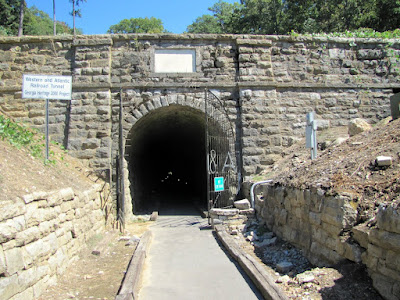
I got lucky this weekend past. I often put things on my list of possible stops along my travels and they are closed and I feel like a moron. But not so this past weekend, I took a two mile detour off 85 to visit a historic place on a day they are usually closed and I stumbled upon their ultimate celebration. I got this lucky in a cool little town a little under two hours Northwest of Atlanta on my way to Chattanooga. The town in question is the city of Tunnel Hill, Georgia and the sight I wished to encounter was their Great Tunnel


The tunnel runs 1477 feet through the Chetoogeta Mountain. It was completed in 1850 and served as the first rail tunnel through the Appalachian mountains and served to connect Augusta and the new town of Atlanta to the Tennessee Valley and up the Northern Coast. It was dedication in October of 1949 and the first train passed through on May 9, 1850. Prior to that railcars were literally portaged over the mountain. The tunnel over time became functionally small so a new tunnel was built a few hundred feet North of the original in 1928 and this one fell into disuse. The tracks were stripped out of it some years later and it was opened to the public in the year 2000.


We arrived on one of the few Sundays the Tunnel Hill Heritage Center was open. They were doing their annual Reenactment of the Battle of Tunnel Hill. We arrived near the end but the ordnance fire was loud and set a beautiful aural tone. There were all sorts of folks in period attire with a nice little market and some of the best handcrafted birch beer I ever drank. We crossed a small covered bridge on foot and made our way to the tunnel. You can now walk the 1500 feet through the old tunnel to the other side. It is a marvel of pre-civil war engineering and makes for cool shade on a hot Georgia day. It is reasonably well lit, but we sort of wished we had brought flashlights. On the other side of the tunnel there was a tremendous patch of kudzu in bloom, with a gorgeous sweet smell. You also get to tour the small railroad museum and walk very near the Clisby Austin House, a fine antebellum building.

Of keen interest here is the history. First there’s the railroad and the tunnel. Secondly, there’s the Civil War heritage. The Clisby Austin home served to house General Hood of the grey and General Sherman of the blue at different times. One of the quirkier landmarks I’ve seen is here and is the gravesite of General Hood’s Leg, which was blown off in battle. The Battle of Tunnel Hill is said to be the first skirmish of the Atlanta Campaign and the campaign was designed in the Clisby Austin home. The tunnel was also one of the targets of destruction by Andrews Raiders during what has become known as the Great Locomotive Chase, but their pursuers were too close by the time they passed through this site. Having all the confederate and union soldiers walking around really brought this history home.


The tour normally costs $5 (hours and admission). And you get to see all the sites mentioned. On the day we went, it was pretty crowded being the big reenactment day and all, but I imagine on normal days it could be quite tranquil and serene. And with its location so close to the 85 corridor, I mark Tunnel Hill as one of the best little roadside attractions I’ve encountered in Georgia, period.


Trail Essentials
Approximate Time: 1 hour
Approximate Distance: 1 mile
Features: Tunnel, Historic Building, Gravesite, Civil War history

Overall Rating: B

Scenic Quality: A
Athleticism: C
Solitude: C+
Value: A-
Parking: Free
Hours of Operation: Monday through Saturday 9am-5pm
Facilities: At Railroad Museum
Maps: None needed
County: Whitfield


Flying Machine at Gwinnett Briscoe Field

The Gwinett Briscoe Airport, Fun amid Controversy Map
From Flying Machine

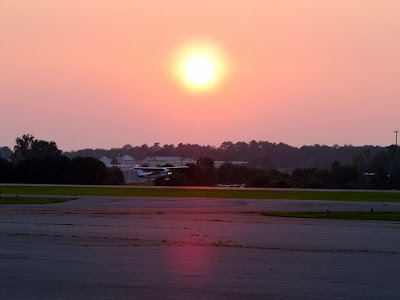
Ok, this one’s a little nepotistic because a good friend of mine runs the joint. But there used to be a time when I was younger when I would sit out on Frontage Road outside Orlando International Airport and watch airplanes take off and land as a nice way to pass the evening with a special friend. With the onset of terrorist watches, you can’t sit out on that road anymore without being moved along by police. However, you can still get the same experience (while it lasts), at the Flying Machine in Lawrenceville, Georgia.


Now, I wish I had more photos of the food and bar area, I thought I had enough from previous visits. Briscoe Field is a small airport, which may be getting bigger, but currently is capable of handling light aircraft and corporate jets. The volume of air traffic isn’t huge, as it is almost entirely private planes, and is affected for better and worse by the quality of the day’s weather. During my last day there, we saw about a dozen planes use the runway over a two and a half hour period on a Sunday Afternoon.


As for the food, you get solid pub food done at fair prices (Menu). The $100 burger costs $6 (the higher price due to the cost of flying your plane in to get one). They have a few beers on tap, all domestics, with a wallet friendly $2.75 price. And a couple of dozen more in the bottle (I drank Landshark for $3.99). It is a very nice place to have a drink and some food on the patio, with the planes creating a nice backdrop.


They are also well known for music, particularly country music. The proprietor, who uses the name, Hokey Sloan had some minor fame with a song called “I didn’t give her the car.” The day we were there he played a new tune called “Same Ol Same Ol” and the rumor is he’s spending some time in the recording studio. He also played a Conway Twitty number at our request. A number of country acts play through there and you can check their website for a schedule.


What you get is good pub food and drinks at reasonable prices, nice music, and the planes creating a wonderful backdrop for you and your friends. I’m surprised more kids aren’t there as the place is family friendly and the children we saw were enthralled by the speeding aircrafts. And if the recent brouhaha about privatizing the airport comes to fruition, you might not have that much more opportunity to chill at Gwinnett’s quaint little airstrip. So you better get while the getting’s good and enjoy while it lasts. You can tell him I sent you (Hokey knows me as Doug).


Restaurant Fundamentals
Address: 510 Briscoe Blvd, Lawrenceville GA 30045 ( Gwinnett County)
Phone: 770.962.2262
Website: www.theflyingmachine.com

Cultural Significance: B+
Food Quality: B
Healthiness: C (its pub food remember)
Price: A
Value: A+

Overall Rating: A-

Recommendations: Burgers and Beer, topped with Hummingbird Cake
Significance: A Deck literally right on an Airport Runway, Country Music

Gwinnett Environmental & Heritage Center

CLEAN LIVING IN BUFORD Map
Gwinnett Environmental & Heritage Center
From Gwinnett Environmental and Heritage Center


(note: the trails are completely free, but the center itself charges a small admisision, that is why this is categorized as Free, and Under $10 a person)


About 4 years ago, a new idea came to fruition in Gwinnett County. An idea to build a type of nature preserve on Ivy Creek. As a person always looking for a getaway that doesn’t require too much getting away, I rejoice in these endeavors. What Gwinnett County has built is something of a marvel, spitting distance from the Mall of Georgia in Buford. Sure its an hour away from Atlanta, but for us Gwinnettians, its right in our backyard. And it is known today as the Gwinnett Environmental and Heritage Center (abbreviated as GEHC).
GEHC Green Building

The main building itself is a bit of a wonder in its own right. Unlike other similar nature centers like Autrey Mill, they leaned a little more to the future than to the past, creating a modern building and focusing on the science of nature. The main building a gold certified green building, meaning that it is at the forefront of energy conservation, and it carries several hands on exhibits about the nature and ecology of the area. I personally didn’t enter the building, being more interested in the trails, but the reviews are pretty stellar, especially from children. They are open 9am to 4pm, Monday thru Saturday, with the exception of 8 major holidays and the cost is $7.50 (adult), $5.50 (Seniors and ages 13-22 with Student ID), or $3.50 (ages 3-12), with a $3 additional charge for non-Gwinnett residents (Admission Pricing Here) . At this point the exhibits focus mostly on Water conservation, but there are rotating exhibits. The building is also a popular event facility for weddings and the like.
A look at the Trail

Like I said, I went for the trails. There are 4.8 miles of unpaved trail with and additional 2.9 miles of paved trail listed as 11 separate trails. The dirt trails are mostly short bursts that vary from .1 to 1 full mile, so my suggestion is to do several of them to get your exercise. I kind of wandered through several of them alone with no map or actual destination. What I found was an enjoyable wilderness setting, minutes from the hustle and bustle of the Mall of Georgia. There are some ups and downs but nothing too difficult (their ratings are on the map here). The best trails in my opinion were the sweet gum (because of the distance) , the two more strenuous trails (Forest Ecology and Holly), and the Ivy Creek Greenway (mostly for the Ivey Creek views). The Homesite loop trail has potential as they are in the process of collecting some old buildings, most notably the Chesser Williams House , but there is nothing there as of March 2010.
Chesser Williams Future Site

Taken as a whole, the Gwinnett Environmental and Heritage Center is a serene oasis in a busy part of Gwinnett County. Children and families should love it. And its destined to get better as they add improvements and exhibits. I couldn’t help wishing I had brought my bicycle as I thought it would be a fantastic bike path. I saw no bikes the day I went, but the website says they encourage bike enthusiasts to use it.
Ivy Creek and Bridge Ruins

Trail Essentials
Approximate Time: Varies
Approximate Distance: anywhere from 2-7 miles
Trail Surface: paved, gravel, compact soil
Features: Modern Building, riverside walks, bridge ruins
Overall Rating: B
Scenic Quality: B
Athleticism: C
Solitude: B+
Value: A
Parking: Free
Hours of Operation: Trails Dusk to Dawn
Facilities: at Vistor center
Maps: map here
County: Gwinnett

Panola Mountain

THE MOST NATURAL AND UNDISTURBED MONADNOCK OF EXPOSED GRANITIC ROCK IN THE PIEDMONT BIOPHYSIOGRAPHIC PROVINCE. Map

From Panola Mountain


I just love the above sentence.  I usually make up what I think are catchy little titles to my posts, but what could possibly draw a reader in better than that sentence.  To be honest, I had to look up one of the words, only because I’ve come across monadnock previously.  But apparently, we Atlantans live 30 minutes west of “the most natural and undisturbed monadnock of exposed granitic rock in the Piedmont biophysiographic province.”  And I believe its something you should know about and see, so I’m going to tell you the story of hiking Panola Mountain and Panola Mountain State Park .


Panola Mountain is a National Natural Landmark and the centerpiece of the Georgia State park of the same name.  It is a granite mountain similar to Stone Mountain or Arabia Mountain .  If Arabia Mountain is Stone Mountain’s quieter brother, Panola Mountain is the third child locked in his room to keep him from harm.  As a matter of fact, there are no public trails to its summit.  The public trails at the park are only 2 miles long and take you along the base of the mountain (there’s also a fitness trail at about a mile).  So I put this trip off for a long time because I didn’t want to drive a hour for a two mile walk (I live North of the city).   So I made my pilgrimage on the way back from another state park further East.


And I got lucky.  I had heard that they had ranger led guided tours that scale the summit, but they were always at 10 am on Saturdays, which is very difficult for me to make (I work a majority of Saturdays, thus the focus of this site on Sunday daytrips).  The plan was to stop and do the self guided trail along the base of the mountain, but they have started something new: what they call the Mountain Top Owl Prowl , which takes you on a guided trek up the mountain as the sun is setting.  Normally you have to make reservations (call 770-389-7801) and they limit the group to 25, but the nice guide Jeff expanded the group to 27 to make room for the baboon and one companion.


The reason the mountain is off limits to untrained and unescorted personnel is to keep the mountain natural and undisturbed.  It is home to many species of lichen, moss, diamorphs, and herbs that just don’t exist anyplace else.  Some are endangered, some are endemic to granite outcrops, and some are just plain rare.  So even though you are climbing to the 940 foot peak (the elevation gain is only about 250 feet), the star of the show is literally at your feet.  You walk near and, in some unfortunate cases, over a patchwork quilt of yellows, reds, greens, greys and blacks which is visually quite stunning.  But you do your best not to walk on them, if you crush them they are dead and will not be back for 800 or so years (Try growing a plant on a rock and see how long it takes).  The colors come from such species as Vigueria Porteri, Minuartia Uniflora, and the most famous red Diamorphia Smallii, just to name a few.  You will walk up single file and the guide will tell you to do your best to walk in the preceding persons footsteps, and tell you which colors are better to walk on if faced with no other choice, but I forget the order.  Eventually, there will be a path made by the added hikers, and I guess the added attention to the park will help preservation in the long run.


You will also get to see the sun set over Atlanta, which is always nice.  You may see some wildlife like deer or owls, but we did not.  The granite rock in and of itself is quite picturesque.  There are also some old cabins owned by the Yarborough Family (who previously owned the land) and a very serene little pond.  In additon to the owl crawl (1st Saturday of the month at 8pm), and the Every Saturday 10 am hike, but they have also added a Sunday hike (2nd Sunday of each month at 2pm), so the opportunity to visit has expanded to 150 people a month and accommodates folks of differing schedules.  The owl crawl is probably only 1.5 miles as you drive to a different parking area to save on time and light, but the other two go a full 3.5 miles.  There is a cost involved, the hike costs $7 and there is a $5 parking fee as all Georgia Parks have. [All fees and times are current for April 2010, check their Website ] And remember reservations are required.


I hope I didn’t scare you off with the rules and fees, because it is truly a unique experience I am very grateful for having done.  You see the most beautiful things that would make you scrunch your nose in disgust, if you saw it on a loaf of bread.  You scale another of Georgia’s great peaks.  And the money supports the great natural treasure of Panola Mountain and our great resource of Georgia’s State Parks.


Trail Essentials
Approximate Time: 1-1.5 hours (Night Owl Crawl)
Approximate Distance: 1.5 miles
Trail Surface: compact soil, granite, small life forms
Features:  rare species of flora, mountain peak, panoramic views
Overall Rating:
Scenic Quality: A+
Athleticism:  A-
Solitude: A+
Value: A
Parking: $5  
Hours of Operation: Special for hikes, see text
Facilities: At the visitor center
Maps: Guided tours none needed, at visitor center for self guided trail.
County: border of Henry and Rockdale County, near Stockbridge.

Cave Spring, GA

Authentic Small Town Life map

From Cave Spring, GA


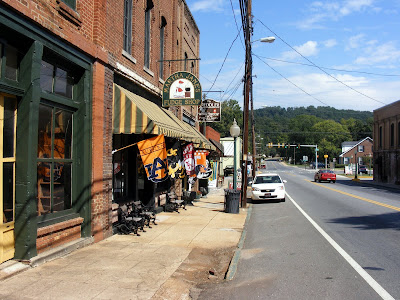
Growing up in the second largest city in the USA, I used to watch reruns of The Andy Griffith Show and wonder if anyone actually lived like that. At the times when the pace in Chicago was too frenetic or overwhelming, I would daydream about living in a town like Mayberry: Simple Life, genuine people, simple pleasures. Atlanta, as interesting as it is nowhere near this idyllic picture, but about an hour and a half Northwest of town, I found a place that claims this lifestyle, and better yet achieves it. I truly enjoyed my short stay in Cave Spring, GA.

Now, if you don’t read any further and just look at the pictures, remember this one thing, bring some empty water containers (I’ll explain later).


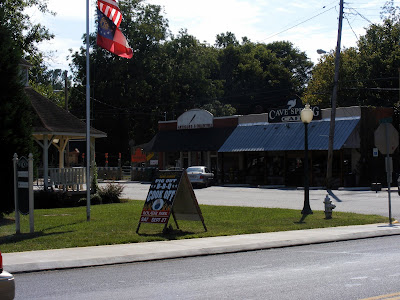
Cave Spring is a town of a little under 1000 people. It’s the embodiment of Georgia small town life and is proud that it only needs one stoplight. But unlike many little villages that dot the highway here and there, this town about 15 miles outside of Rome has two very distinct advantages: First, the people and businesses are open and welcoming, and, secondly, it has a unique geographical feature that makes it worth the trip.


We started the day, with a fine breakfast at the Cave Spring Café . Too often I get to a little town and the place looks quaint and charming, but the shops and restaurant are shuttered and locked. But the folks at this café were happy to see us even though we arrived shortly before closing (they close at 4pm on Saturday and Sunday). I enjoyed a genuine country breakfast with eggs, hand cut potatoes, and homemade sausage gravy. They had lunch and dinner on the menu also, along with some fine looking desserts. Another location, the Tumlin House Bed & Breakfast, does a fine dining feature only on Saturday nights, but we weren’t there on Saturday (If you go, drop me a note or add a comment).


We then walked around the downtown square. We were able to enter 6 different establishments and the specialty of the town must be antiques. Different locations were varied from high end to low end, but all the proprietors were smiling, friendly and willing to converse. I bought a couple of old fashioned rocks glasses that were marked a buck a piece, but the lady gave me them both for a dollar.


I asked one gentlemen when Rolater Park closed, and he said. “doesn’t really close, it’s a park?” This made we wonder how we devolved to a place where our parks always close. How do you lock up a tree? Why should we need to close off a nice field of grass or a stream? This is one clear way the people of Cave Springs are better than us: they trust each other and other people.


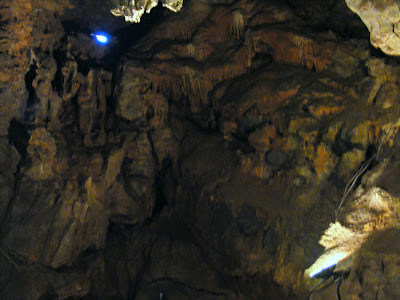
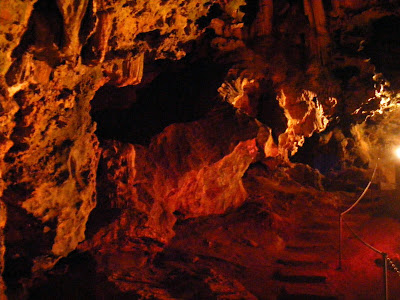
The park contains the fascinating geographical attribute that makes the trip worthwhile. Since the town is called Cave Spring, that’s exactly what’s there, a cave and a spring. The Cave does close, normally around 6 pm on weekends and 5 pm weekdays, but they say they stay later if people demand it. It costs a whopping $1 a head to enter the cave, and the rock formations are beautiful and the temperature is cool for those hot Georgia days. It is very easy to navigate and virtually anyone, even those with wheelchairs could traverse the first ¾ of the trip. The last portion has some large steep rock stairs with a heavy chain fence to assist your climb, but even if you don’t get that far its clearly worth the dollar.


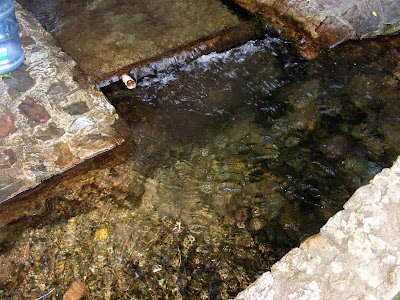
Outside the cave there is public access to the Spring. At the entrance to the cave they will provide you will a small cup so that you can taste the naturally clean, cold water. But you probably will want to bring along some jugs to carry some of this free, natural water back to your life wherever it may be. I was a little taken aback at first at the thought of drinking water from a spring, but I saw a steady stream of townies, driving up to load up their clean water for the week. The water tasted pure and refreshing. I asked the one gentleman if it was safe, he said that the Spring starts somewhere deep in the mountain and “No one can get to it to mess with it.” He also explained that the same water is delivered to all locations in town and also to the Alabama town of Fort Payne. But the purists like it straight from the spring because they don’t add that “touch of fluoride” they are required to because of city requirements. I thought that this was another way the people of Cave Springs were superior to me: I was afraid to drink water from a natural stream, the way people have for thousands of years, and they knew how this was supposed to be.


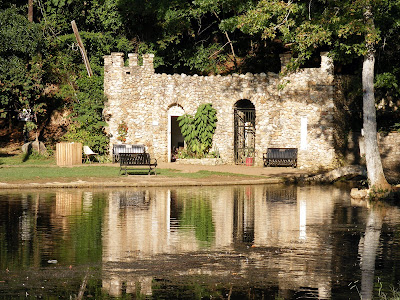
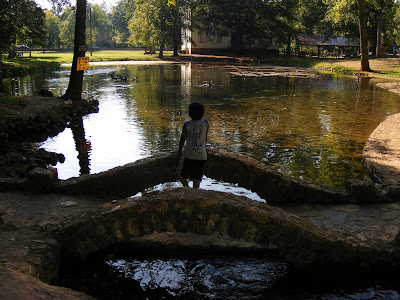
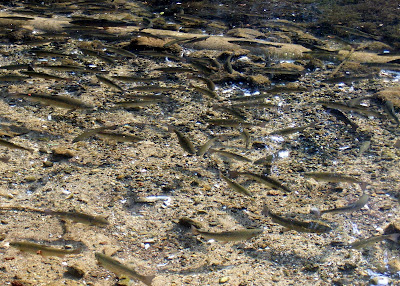
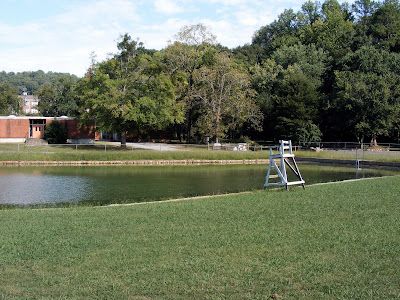
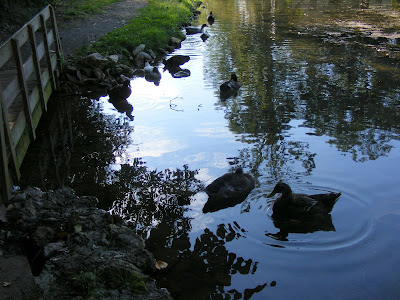
The spring then feeds a small pond that’s just chock full of trout, easy to see with such crystal clear water. No, you can’t fish there (except kids on one day a year), but for a quarter you can buy some fish food, feed the trout, and watch them scramble for it. The pond also has a fine contingency of ducks to watch and feed too (maybe bring some bread?). The pond then feeds a shallow wading stream that you can dip your feet into to sense it cool refreshing waters (at about 60 degrees anytime of year). And yes it was cold. The stream then becomes a place where fishing is allowed, but is also diverted to a swimming pool (open during the summer), where kids can have a fine time on a hot summer day.


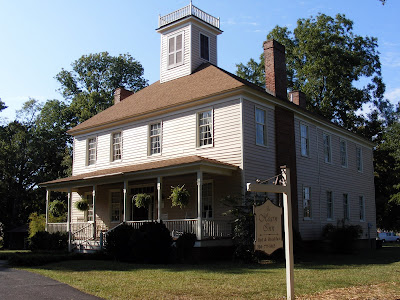
Inside the park, are also a handful of historic buildings (info on the buildings ), including Cave Spring Baptist Church (built before the Civil War), the Hearn Academy (originally a learning academy called the Manual Labor School), and the Hearn Inn (a currently functioning bed and breakfast in the heart of the park). They are open for certain functions, but weren’t the day we were there.


As I was leaving the park, I saw the one law officer (who looked nothing like Andy Griffith) sitting in the gazebo, 20 feet from his car, reading the paper. This place wasn’t Mayberry, but did a fine approximation. Cave Springs is the town that claims to be life the way it was, and maybe the way it is supposed to be. Many other places claim this, but this place does it. I have seen it with my own eyes, take a short drive and you can see for your self.

The Varsity

Atlanta’s Premier Restaurant Map
The Varsity Drive In
From The Varsity


I’ve been wanting to expand into writing about restaurants and shops around Atlanta but have been putting it off because there seems to be a lot of that kind of thing going around. My contention is that you would have to be an idiot or a complete snob not to be able to find a good meal in this great and diverse city. But an anonymous poster on my picture index page reminded me that restaurants can be more than restaurants, they can be events, they can be special places, and, in certain cases, they can be icons of Atlanta Culture. I always said to my foodie friends that no matter how good the food gets in this metropolis, the two most recognizable restaurants in Atlanta will always be “The Big Chicken“ and the subject of this post, The Varsity . With this gentle reminder, plus the PBS special about the place airing on September 6, 2008 at 8 pm (view trailer ), I decided the time has come.

The Varsity from the Parking Lot

The Varsity, bills itself as the world’s largest drive-in, can serve up to 30,000 folks on a given day, and has been serving our fair city since 1928. To my friends who attended Georgia Tech, they speak wistfully about the fast food joint as if it was holy ground, the way I might talk about my visit to St. Peter’s in Rome. To have that effect it must be something special. I must admit that I had never eaten at its downtown location since moving here, and based on the performance at its satellite stores, I was never in a hurry to go.

Counter Service 'What'll ya have'

But, a few friends of mine were headed downtown, a little late after church one June morning. We were hungry and we needed something quick. And the Varsity sounded so much more interesting than other fast foods. We pulled in as an added excursion to our day.

Varsity Fries, Rings, Burgers and Dogs

My First Impression was the enormity of the place. The lines were 3-5 deep and at a dozen different registers. And each and every patron was greeted with a chorus of “What’ll ya have?” just like I was told. My absent Tech friends always swore by the Chili Slaw dog, but I wanted to understand the place in full, so I had a chili cheese hamburger and chili cheese hotdog combo (the #2), with fries and rings to share, and the other two recommendations for a true varsity experience, a frozen Orange and a fried peach pie. I paid for three people in our group and the bill didn’t exceed thirty dollars, and it could be much cheaper (menu & prices ), if you ordered less (We wanted to embrace the experience in full), so I would gauge this a fairly cheap place to eat. We moved to sit in the expansive atrium, which hit me with the next great impression of the downtown location, a terrific view of the city of Atlanta. The Olympic Torch blazed to the North, the west overlooked the 75/85 corridor, and the South gave a really nice view of the Atlanta Skyline. I thought it a great starting point for a foray into the city.

Fried Peach Pie

Back to the food, and I must be honest about this, the Hamburger was nothing special, so I would echo the Techies, and say you ought to go with the dogs at this place. Not that the hotdogs are earth shattering, but they are solid. Where the dining gets good at the Varsity are in the extras. The French Fries and Onion Rings are handmade and fantastic. The Frozen Orange was to me, a Native of somewhere else reminiscent on a childhood favorite the Orange Push-Up and refreshing on a Georgia Summer day . I am not a huge fan of desserts, but the Varsity pies were a clear notch above other fried pies I’ve had in my life. The experience certainly wasn’t healthy (we knew that going in), but was enjoyable. Even the one Chef friend of mine remarked, “it was fine.” A high compliment from a critical palate. His children were in heaven as I believe it may have been the first time in their lives their father took them out for fast food (and they are in their early teens). They let us put on the classic Varsity hats and we acted like goof balls for half an hour.

The Classic Frozen Orange

This place does what it sets out to do. It serves Atlantans quality fast food, at fair prices quickly. Just as it did for your father and his father, and will for your son and daughters and there sons and daughters.

The World's Largest Drive In

The place has a gift shop, ample parking, and a lots of drive up carhop style serving areas. In the 1940’s comedian Nipsey Russell worked there and honed his comedy while working as a bell hop. They have there own Lingo in calling out the orders, that gives it an old diner feel. There is a great Coffee table book about the store that could fit properly in any Atlanta Living room. They do have several satellite locations, but the true experience is at the corner of North and Spring Street. And Like I said, this is Atlanta’s First Restaurant, and in that role, I’ll echo my culinary compadre’s words: It does a fine job.

the Varsity and Georgia Tech

Restaurant Fundamentals
Address: 61 North Avenue, Atlanta, Georgia (Fulton County)
Phone: 404.881.1706
Website: www.the varsity.com

Cultural Significance: A
Food Quality: B+
Healthiness: D
Price: A
Value: A

Overall Rating: A-

Recommendations: Stick with the dogs, Frozen Orange, Fries and Onion Rings, and the Fried Peach Pie
Significance: An Atlanta Institution for 80 years

ShareThis

Related Posts Plugin for WordPress, Blogger...