Showing posts with label Direction-S. Show all posts

Auchumpkee Creek Covered Bridge

We can rebuild it…. Map
From Auchumpkee Covered Bridge


OK, Some may criticize this post as just another covered bridge post in my seemingly endless quest to view and photograph every covered bridge within a reasonable drive of my home just outside of Atlanta, and to them I say sure you are right. There is something strangely attractive and compelling about covered bridges and I have been sucked in. This doesn’t make the covered bridge less cool, I really love seeing this friendly reminders of a bygone era in the Georgia Countryside. Today, I bring you a bit of information and photos of the Auchumpkee Creek Covered Bridge, just 1½ hours South of Atlanta, near Culloden in Upson County, Georgia.


The original bridge was built in 1892 by Herring and Alford, in the Town Lattice design. It spans the Auchumpkee Creek, originally at 120 feet in length, but currently at 96 feet. It has also been called the Hootenville Bridge, after the community of Hootenville that was once there. And Zorn’s Mill Bridge based on a nearby and now missing mill.

It seems the bridge was restored twice. The first one in 1985 was more of the general restoration you see in a lot of these bridges. The latter in 1997 came after terrible flooding in that part of Georgia destroyed the bridge, this was done by the firm of Arnold Graton & Sons. They used as much of the old bridge as possible, but there’s more new here than old. But I’m glad to see that it is truly in the spirit of the original bridge.

The bridge is located about 40 feet off the of Allen Road, a little bit East of GA 19 and about 10 miles South of Thomaston, Georgia. In addition to the bridge, the stream is pretty and apparently a decent place to fish. There is one picnic table that we utilized with pleasure. There are no facilities at the site.

So if you are a Covered Bridge Buff and want to see another of these quaint pieces of history, Auchumpkee Creek Covered Bridge is a pleasant diversion. It is held up well because of the rebuilds and the distant location has limited the destructive influences.


Sprewell Bluff State Park

The Flint River in Danger again map
From Sprewell Bluff


Whenever I read a story about Atlanta’s water supply and the disputes surrounding, one side note has always intrigued me. Basically, in addition to the creation of reservoirs on the Etowah, Chattahoochee, and Savannah rivers, there were plans to build a reservoir on the Flint River. But, due to its natural beauty, then Governor Jimmy Carter gave the Flint River a pardon. I know that the Flint flows through areas of Carter’s childhood, but I wanted to see what he saw. And I wanted to see it before it goes away. The best place to look is at the former proposed site of the dam, which is now Sprewell Bluff State Park, located just under 2 hours South of Atlanta, near Thomaston.
Now the other curious thing about this park is on the state web page under activities, it lists among the usual culprits, the quite unusual rock skipping. It’s not unusual to skip rocks per se, but it is unusual to list that among things to do. At Sprewell Bluff, they even have an annual rock skipping contest on Labor Day weekend. Even though I’ve said it was strange, as you stand on the bend of the river, you can’t help but think, “This is a great place to skip a rock.”

There is also a 3 mile hiking trail. it runs up and down the bluff to the river in a series of loops with out and backs at each edge. At one edge you head out to a natural dam, and at the other you pass by an overlook with a nice birds-eye view of the river and it ends at the aforementioned Rock Skipping place. It’s a nice peaceful trail with some elevation gain and loss, enough to call it decent exercise. And the river itself is beautifully tranquil. After walking the trail, we ended the day, grilling burgers at the side of the river.


So what did Jimmy see? The natural beauty of the Flint River winding its way through rocky bluffs, a great place to fish or canoe, or maybe he just sat there and skipped a rock. Any way you slice it, Sprewell Bluff State Park is peaceful getaway, I’m glad to see preserved intact. With the water problems we have, let’s hope that the idea of damming the Flint is not rekindled.

Trail Essentials
Approximate Time: 1-1.5 hours
Approximate Distance: 3 miles
Features: River Walk, Shoals, Long distance River Views

Overall Rating: A

Scenic Quality: A
Athleticism: B
Solitude: A
Value: A
Parking: Standard State Park Rates ($5 2011)
Hours of Operation: 7am - Sunset
Facilities: At Picnic Area
Maps: here
County: Upson


Andersonville,
Civil War Village

Tribute to War Crimes Map
From Andersonville

(Part III of a three part serious on my trip to Andersonville, Part I here, Part II here)

After your stop at the Andersonville National Cemetery, there is one last place one feels compelled to see before departing the area. Across from the gate and the busy highway, stands the gate to the city of Andersonville. A quiet and infamous town, but home to something you won’t find anywhere else. It was here that the chief caretakers of the nefarious prison lived, most notable among them was the Commanding Officer Capt. Henry Wirz.


As you drive into the city, you can’t miss the one-of-a-kind item, I mentioned. It is a stone obelisk rising about 20 feet in the air planted smack dab in the middle of the road in the center of town. And this monument is erected in honor of Captain Wirz, the fabled Demon of Andersonville. Now there are Confederate Monuments scattered all throughout this state and country. And as a real part of our history, I don’t begrudge this fact, provided it is done respectfully and within context. But Captain Wirz was tried, convicted, and hanged for War Crimes. So this memorial is the only monument erected to honor a war criminal placed on American Soil. Some list Captain Wirz as the only man convicted of War Crimes during the Civil War, but there is also historical record of a Tennessee irregular combatant being executed, Champ Ferguson, though his status as a War Criminal is debatable. Another perplexing note, speaking to my feelings about visiting the POW museum, is that Wikipedia’s List of American War Criminals has only 10 entries: one from the 19th century, Henry Wirz; one from the 20th Century, William Calley, architect of the My Lai Massacre (1968); and the other eight entries are from the current century which stands at writing a mere 10 years old.


In addition to the monument, there are the offices of Captain Wirz on the corner. There’s a railroad crossing and a few railcars. There is a diorama exhibit of the prison, but as we arrived late in the day the whole place was closed. It looked pretty much like other small towns in Georgia, but the vacant nature and the area’s history gave it a decidedly eerie feel. Now I don’t buy into any paranormal activity whatsoever, but I can understand why the gullible and so inclined have repeated many Ghost Stories of Andersonville. On the positive side, there is a historical marker to the good Father Peter Whelan who ministered to the prisoners and prison keepers of Andersonville, serving God as if He was neither Blue nor Gray. If you are looking for a hero in this story, Father Whelan may be your best bet.

From Andersonville

Behind the row of buildings on the left side, there is an interesting little city park. A small creek runs through it and they have gathered a number of old wooden shacks to make it quite photogenic. One of the shacks is a jail with a prisoner inside it. There is a kind of cheesy replica mill complete with Christmas lights. But the most fascinating part of the park is a cage containing two beautiful peacocks (well one beautiful peacock and one less glamorous peahen). As they are native to India (and I believe they are of the blue Indian variety), I have never seen any peafowl outside of a zoo or habitat community. To find these striking creatures in the small town of Andersonville’s city park was a perfect, albeit completely out of place, cherry on the top of a grand excursion.


In summary, the prison recalls an awful time in our history. The POW Museum makes us consider our collective humanity. The Prison site makes us shudder at the prospect of how low man can sink. The Cemetery makes us reflect on those who carried our banner. And the city makes us question our views of the past. Our jaunt to Andersonville was something that moved me deeply. I would offer that the historical impact of this area is second only to the Martin Luther King Historic Sites and our Civil Rights Legacy. Now, I’m looking forward to a better meaning of the word, “Civil.”

Andersonville National Cemetery

They hover as a cloud of witnesses above this Nation. Map
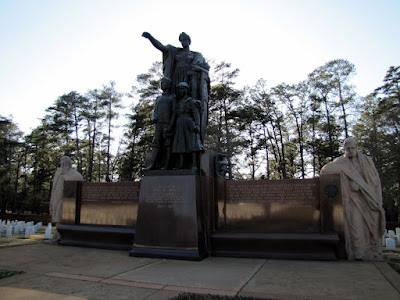
Entrance to Andersonville National Cemetery Statue
From Andersonville
(Part II of a three part serious on my trip to Andersonville, Part I here, Part III here)


The place that I have gone in Georgia that has had the most profound impact on me is my visit to Andersonville earlier this year. So much so, that I have decided to discuss it in three parts. In part one, I talked about the Andersonville Civil War Prison itself and the Prisoner of War Museum, and I’ll admit that I pontificated a little bit. In part two, I will try to avoid that as I discuss the Andersonville National Cemetery.
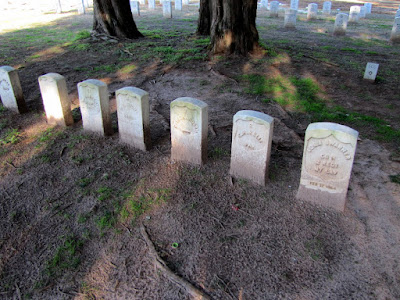
Tombstones of Unknown Soldiers

If you wish to view this place as a good place to take a walk, the additional 1.2 miles here added to the prison site takes the total distance travelled up to 2.7 miles. And if walking isn’t an option, you can travel most of the site by car, though you will have to get out if you are looking for an individual gravesite. And, I must add, even though I walked it, I don’t think that is the way it should be taken.  It should be something more. It is a place of honor: an honor of the solemn trust and memory of those who fought and died for our country.
Monument to Illinois Fallen

The first part of the cemetery contains the 13,000+ graves of the men who died during interment here during the Civil War, most from the armies of the Union States. The grave marked number 1 belongs to Adam Swarner of New York and unfortunately the place closed before I could find the last grave. There are monuments erected by every state that had soldier die in Andersonville throughout these graves. The graves line up in perfect lines on short white marble throughout the middle Georgia landscape. 921 of these graves are marked unknown.
The First Gravesites at Andersonville

Notable among the graves are six gravestones set apart from all the others, not in a place of honor, but in a place of shame. They were the six known as the “Raiders.” They were executed at the Prison for crimes within the prison. With no officers held at Andersonville, the swelling numbers of enlisted men fell into anarchy, and the guards lacked both the manpower and probably the will to do anything about it. The group numbered depending on reports somewhere between 50 and 500 (with best estimates placing it between 75 and 150) and they would steal, intimidate, beat, and sometimes murder their fellow inmates in order to secure what valuables the other prisoners had. After a prisoner named Dowd was beaten and had his money and watch taken, he complained to the guards, and this caught the attention of Captain Henry Wirz, the head of the camp, who decreed that all rations would be cut off until the Raiders were turned in. Building on less well organized protection groups built from squadrons housed together; a rival gang, or rather, police force was formed called the Regulators. They brought the Raiders to justice, held a trial within the prison of their peers, and the six chieftains were court-martialed and sentenced to be hung. The remaining Raiders were forced to run a gauntlet of other prisoners as their penance being beaten by those they formerly terrorized. The six that were hanged were: John Sarsfield, William Collins, Charles Curtis, Patrick Delaney, A. Munn, and WR Rickson (AKA Teri Sullivan), though there is some controversy as to whether these were their real names.
The Andersonville Raiders Graves Set Apart

In addition to the prisoners who died here, the site is a National Cemetery and more of our fallen soldiers have been buried here since the Civil War, pushing the total to above 18,000, representing virtually every war since. Two of whom were Congressional Medal Of Honor recipients. James Wiley fought in the Civil War and died during internment at Andersonville and he is credited with the capture of a Georgia Regiments flag at Gettysburg. The other is actually an “in memory of” headstone, as his body has never been recovered, and that belongs to Luther Story, who was awarded for taking out a truck full of enemy combatants singlehandedly near Agok during the Korean War.
Modern Graves at Andersonville National Cemetery

As I said before, this is a solemn place and the feeling of sadness is palpable. Some wish to attribute this to some sort of paranormal activity, and I like nothing better than a good ghost story, even if it is just a story. But it just doesn’t seem right to do that here (the stories are easy to Google if you need them). Andersonville National Cemetery deserves more respect than that. This place coupled with the POW museum and the Prison, is a must see for all Americans who are able to reflect on our past, our fallen brothers, and the hopes of our future.
Andersonville Prison's Dead

Trail Essentials
Approximate Time: 1-1.5 hours
Approximate Distance: 1.2 miles
Trail Surface: paved and grass
Features: Grave markers and statues
Overall Rating: A
Scenic Quality: A
Athleticism: C
Solitude: A
Value: A
Parking: Free
Hours of Operation: 8am – 5pm
Facilities: At the POW Center
Maps: Not needed
County: Macon

Andersonville Civil War Prison

Hell on Earth in Pleasant Middle Georgia Map
shebangs inside blockade wall
From Andersonville
 
(Part I of a three part serious on my trip to Andersonville, Part II here, Part III here)


I’m a fan of Mr. George Santayana’s work, using one of his quotes, everyday since day one of this project on the front page. Probably, the most often quoted piece of his wisdom is “Those who cannot remember the past are doomed to repeat it.” In this light, I like to embrace the good and the bad of our collected behavior, with a slight emphasis on the bad, which we tend to want to forget or to change, so we don’t feel as “icky” about ourselves in hindsight. Earlier this year I traveled to a place that can lay claim, albeit dubiously, as one of the worst moments of our collective culture, and certainly Georgia history, and I did this at a time where more and more I hear people rooting on the mistreatment of prisoners. The irony, the history, and the sadness is palpable at the Andersonville Civil War Prison . The content of this visit is so grand that I will discuss it in three parts, even though it is easily visited in one setting). This is part one: National Prisoner of War Museum and Andersonville Prison.
staring at the blockade wall

It sits 129 miles South of Atlanta, just over two hours away near the peaceful middle Georgia towns of Americus and Plains. There is no cost to enter save the time required to arrive and visit, so I consider it a shame on me for waiting until 2010 to visit (not even a parking fee). When you arrive, you first enter the National Prisoner of War Museum with the sacred land of Andersonville placed right behind it.
a prisoner of war

The Prisoner of War museum is a fitting tribute to POW’s and perfectly placed at the foot of the infamous Civil War Prison. It truly sets the tone for what you are about to see. And no, it is not dedicated only to the Civil War POW’s. There are displays from virtually every war since. There’s amazing artifacts showing how POW’s survived from food to grooming to toilet paper. There are a couple of facsimiles of cells: one in concrete, one in Vietnam Bamboo. There’s an amazing dark room that uses lighting tricks to try to get you to understand what life might be like to live constantly with a gun in your face. There are correspondences from soldiers who tell their tales. Utilizing an hour of your time in this building will get your mind right for viewing what comes next.
the fields of Camp Sumter

When you exit behind the museum you are confronted with the place that as many as 33,000 Union Soldiers were imprisoned. The first impression is probably the same impression the Confederates who decided on the as the place for the building of a prisoner encampment: a bucolic green field with a small stream running through it. What it was to become was probably more difficult for them to imagine that the modern viewer because of our historical knowledge. On the left side is a depiction of one corner of the stockade walls. Outside the walls is a pillory; inside the walls are makeshift tents called “Shebangs” which are the type of sticks and cloth structures used by the captured soldiers to fend of the Georgia heat. Along the whole of the concourse is the stockade line and deadline: a phantom line today but if crossed at the wrong moment of history meant death by gunshot from guards placed in the towers because any attempt to approach the walls meant attempt at escape.
cannon on star fort

On the backside of the walk, there is a star fort where the commandant of the prison could survey his charges, complete with two replica cannons. There is also the land where the hospitals for the sick were kept. There is another stockade wall on the right side this one depicting entry in the prison camp. Near this stockade is a stonework temple housing Providence Spring , a gift of water to the inmates, that seemingly came from nowhere to give drink to those in desperate need of water. On the near right side is a sort of monument park, erected granite commemorating each states contribution to the internment and dead at the prison. Among these are trees that have types of tunnels built at their base showing the way a prisoner might dig to escape. There are actually a number of small granite markers throughout the site marking filled in water wells or escape tunnels depending on your viewpoint.
providence spring

The prison was a difficult place to live and a difficult place to face even in the 21st Century. Pictures of emaciated inmates seen either online or in the museum are difficult to forget. The stories of mistreatment and even prisoners roughing up other prisoners are sickening. It makes me think of my family and friends who have served this country past and present. It makes me think of John McCain. It makes me think of the stories about us at Abu Ghirab and Gitmo, but I digress.
Prisoner Monuments

I know there are a lot of causes for the starvation and sickness that ran rampant through this camp, and I won’t pass judgment. I know Captain Henry Wirz was following orders and had limited supplies. I know that the North refusing to recognized the Confederate Nation led to the end of prisoner exchange and the swelling of the ranks at the Camp. I know about the Union’s version of Andersonville at Camp Douglas in my hometown. The bigger picture is what weighs heaviest on my mind: Of what are we made that allows us to act this way toward our fellow man? Do we have the dignity and courage to rise above this flaw in our makeup and become the noble beast I think we all want to become? Is the past prologue? Do we ever learn? Does one person’s abandonment of morality give me the moral authority to do likewise? Can two wrongs actually make a right?
cross and you’re dead

The history of the place is easy to find and I will include some links (here , here , and here ), I wanted to simply give you an impression. The walk is paved and only gently graded and runs about 1.5 miles. If you can’t walk it, you can drive for most of it. I would place this historic site on the list of must see, not simply nice to see or ought to see.
back at the POW museum

ShareThis

Related Posts Plugin for WordPress, Blogger...